Insights

Spotlight:

Rouse Hill: 49% growth and counting

As Sydney continues to expand, Rouse Hill has emerged as one of the most notable growth areas in the city’s north-west. Over the past five years,....

All Insights

blogs

Navigating Risks in Real Estate Private Credit

Real estate private credit, as an asset class, is inherently risky.

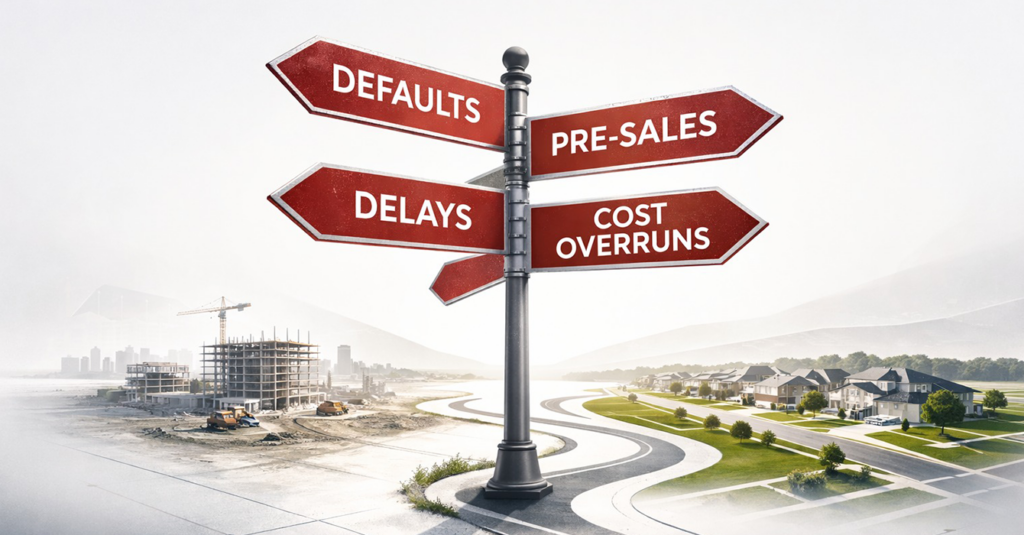
Defaults, delays and aggresive valuations are a natural part of the landscape, and that is precisely why the returns are attractive.

But risk and recklessness are not the same thing.

In this article, we break down how FivePearls navigates these risks to continuously deliver strong risk adjusted returns for our investors.

1) Asset Class Risks

Construction Costs and Project Delays:

Vertical construction—particularly medium- and high-density apartment projects—is under unprecedented pressure. Complex engineering, multi-year build timelines, and a structurally undersupplied labour market significantly increase the probability of cost overruns. Even minor issues, such as engineering oversights, material shipment delays, or small scheduling disruptions, can extend timelines and compound financing costs, turning a profitable project into a loss-making one before the structure is complete.

Pre-Sales:

Apartment developers are often required to lock in prices years in advance through extensive pre-sales. In a market with sustained property price growth, this can mean forfeiting meaningful upside that could have been captured by selling at completion.


Apartment

Land Subdivision

Development Cost per Dwelling

>$350,000

$140-170,000

Typical Construction Timeframe

24-36 months

12-18 months

For private investors, the challenge is gaining exposure to these markets without having to buy and manage property directly, which is why more are gravitating toward property funds as a strategic entry point.

Mitigation: Avoid vertical construction risk.

By focusing exclusively on “horizontal” land subdivision, we avoid many of the variable risks inherent in vertical building. Civil works (roads, drainage, and utilities) are generally more predictable, more standardised, and delivered in a shorter timeframe. Land developers can also stage lot releases, effectively drip-feeding supply, allowing them to capture upside progressively as each stage is released.

Mitigation: Choose the right developer.

Speed and experience are the best hedge against  cost overruns.

A developer with a proven track record, specifically within the same Local Government Area (LGA), often has intangible “planning alpha.” They understand local council processes and common friction points, which are frequently the primary drivers of approval and delivery delays. We prioritise developers who have consistently demonstrated the ability to move from DA approval to titled lots with high execution efficiency.

2) Location Risk

 Regional or sub-prime markets often lack the deep, consistent buyer pools seen in major capitals. Weak or inconsistent demand directly reduces the absorption rate. A project expected to sell out in 12 months may take 36 months, causing holding costs to escalate and materially eroding profitability

Mitigation: Avoid sub-prime and non-urban markets; focus on Sydney only.

Sydney land benefits from structural scarcity and strong population growth. It is more than 50% more expensive than Melbourne and roughly double the price levels of Brisbane, Adelaide, or Perth.

Land, even in the suburban outskirts of Sydney such as Box Hill, can command prices of ~$3,500 per square meter; over $1,000,000 for a 300 square meter parcel of land.

Persistent demand paired with constrained supply supports stronger sales velocity, reducing the risk of prolonged absorption and extended holding periods.

3) Credit Risk

In a subordinated debt structure where returns are higher, but the investment ranks behind a senior lender, the margin for error in security assessment is minimal. The most critical discipline in private credit risk management is valuation methodology. Some lenders underwrite against “as-if-complete” basis, which relies on optimistic assumptions and can obscure downside risk.

Mitigation: Use extremely conservative LVR and “as-is” valuation
After comparing 3 years of independent valuations, we lend against security on the most conservative “as-is” valuation, maintaining a minimum 50% loan-to-value ratio (LVR). The advantage of working with large-scale, well-capitalised developers is balance sheet depth. Rather than relying solely on security over the project site, we may also take security over other land assets owned by the developer. By utilising these assets as additional collateral, repayment capacity is supported by tangible, current land value, not solely by successful project completion.

CBRE forecasts the size of Australia’s real estate private credit sector to increase from $50bn currently to $90bn by 2029.

Real estate private credit offers a compelling return premium, but it is not an asset class that rewards a passive approach. The risks are real, varied, and demand constant attention. Developer defaults, builder insolvencies, and aggressive valuations do not manage themselves.

This is why the quality and integrity of your fund manager matters as much as the opportunity itself. A disciplined manager with a rigorous underwriting process and a genuine commitment to investor outcomes is a necessity. At FivePearls, that responsibility sits at the core of everything we do. Across all of our funds, we have maintained zero loss of capital and zero loss of stipulated returns for our investors.

Not by avoiding the complexity of this asset class, but by navigating it with the care and discipline it demands.

Sydney post

Sydney: The Powerhouse Shaping Australia’s Property Future

At FivePearls, we believe that good decisions start with good data. Our investment philosophy is grounded in facts, trends, and long-term market realities, and nowhere is that more important than in understanding Sydney’s property market. This is not just a local housing story; it’s an economic narrative that impacts all of Australia.

Sydney’s property market isn’t just the heartbeat of New South Wales; it’s the pulse that drives the entire Australian real estate landscape and a significant pillar of the national economy. Its influence stretches far beyond the city limits, fueling growth in satellite regions like the Central Coast, Newcastle, and Wollongong, and setting the benchmark for property values across the country. But this powerhouse faces a looming challenge: land is running out. With geographic constraints, national parks, flood-prone zones, and tightening urban codes, Greater Sydney is on a trajectory toward vertical growth as early as 2046. In this context, residential land from raw blocks to fully developed sites remains one of the safest and most strategic asset classes, underpinning both Sydney’s resilience and Australia’s economic stability.

1. Sydney’s Market Dominance and National Influence

file_2025-10-02_07.11.53

Sydney continues to hold its place as Australia’s most valuable and influential property market. According to the latest Domain House Price Report (June 2025), the median house price sits at approximately $1.72 million and units at around A$835,000. Over the past decade, property values in Sydney have surged by nearly 97%, with close to 34% growth in just the past five years.

On a global scale, Sydney remains one of the least affordable housing markets in the world. Recent studies show that purchasing a median-priced home now requires household earnings nearly 13 times the average income in New South Wales (~A$81,000), placing home ownership further out of reach for many Australians.

This matters because Sydney doesn’t just reflect market conditions; it shapes them. Its trends set expectations for buyers, investors, and policymakers nationwide. When Sydney moves, the rest of Australia listens.

2. The Ripple Effect Across NSW and Beyond

file_2025-10-02_07.12.05

Sydney’s housing pressures ripple outward into surrounding regions. Cities such as NewcastleWollongong, and the Central Coast have seen steady demand growth as priced-out buyers look for alternatives within commuting range. This migration fuels local economies but also intensifies housing demand, pushing up prices and rents in these areas.

At a macro level, New South Wales contributes over 30% of Australia’s GDP, roughly A$660 billion annually. If it were an independent nation, NSW’s economy would sit ahead of countries like New Zealand and South Africa. Sydney’s property market is central to this performance, feeding a wide ecosystem of jobs, infrastructure investment, and consumer spending.

Overlay this with Australia’s current housing shortfall the nation builds roughly 180,000 homes a year against demand for 240,000 and Sydney’s role as a benchmark market becomes even more critical. High net migration, with 446,000 arrivals in 2023–24, adds further pressure to already constrained supply.

3. The Looming Land Shortage

Greater Sydney’s physical and regulatory landscape places hard limits on future growth. National parks, protected waterways, flood-prone zones, and established low-density suburbs restrict sprawl. According to NSW planning forecasts, the city will add about 172,900 new homes between 2023 and 2029, averaging fewer than 29,000 a year, barely enough to meet current demand, let alone absorb future growth.

Industry estimates suggest that by 2046–2050, Sydney will effectively run out of easily developable land. At that point, the city’s evolution will depend heavily on vertical growth and higher-density zones, a shift already underway as the state government overrides local resistance to allow mid- and high-rise development near transport hubs and commercial precincts.

The cost of bringing new supplies to market is another barrier. For a typical Sydney house-and-land package, buyers face A$576,000 in taxes and regulatory charges, almost equal to the cost of land, labour, and materials combined. These costs slow development and inflate end prices, further constraining affordability.

4. Residential Land: The Safest Strategic Asset Class

The Safest Strategic Asset Class

In a city defined by scarcity, residential land has proven remarkably resilient. From raw acreage to serviced lots, its value trajectory has been consistently upward over the long term. For investors, land in Sydney is not just a commodity it’s a strategic play on the city’s growth, infrastructure investment, and population trends.

Land development also underpins the broader property market. When raw land is converted into housing, it creates a multiplier effect: jobs in construction, demand for materials, expansion of infrastructure, and ultimately, new communities. As Sydney transitions toward a more vertical profile, the ability to identify, secure, and optimise land assets will be a decisive factor in both market performance and economic stability.

In Conclusion, Sydney’s property market is more than a local real estate story, it’s a national economic driver and a bellwether for housing trends across Australia. Its influence reaches into regional cities, interstate migration patterns, and the broader financial system. But with developable land running out, the city’s future will hinge on innovative planning, efficient land use, and strategic investment in vertical growth.

At FivePearls, we study these trends relentlessly because they form the foundation of smart, ethical, and forward-looking investment. As a data-focused company, we believe that understanding the forces shaping Sydney today is the key to building sustainable value for tomorrow.

Property Funds in Global Metropolises

Property Funds in Global Metropolises

Picture1

At FivePearls, we believe great investment decisions are as much about the structure of the investment as they are about the location. This article reflects our opinion on how property funds across a variety of structures can be used to access the growth of the world’s most dynamic cities. It is not financial advice and should not be treated as such.

1. Capital Cities as Long-Term Economic Engines

Cities like London, Sydney, New York, Seoul, Singapore, Toronto, Paris, and Tokyo share a rare combination of economic clout, global connectivity, and real estate scarcity. They set property value benchmarks for their countries and act as magnets for capital.

Even during periods of economic turbulence, these markets tend to recover faster due to:

  • High population density and continual demand.
  • Limited developable land and strict planning controls.
  • Status as global business, finance, and cultural hubs.
  • Deep liquidity and institutional investor participation.

For private investors, the challenge is gaining exposure to these markets without having to buy and manage property directly, which is why more are gravitating toward property funds as a strategic entry point.

2. The Broad Spectrum of Property Fund Structures

The-Capital-Stack

When we talk about “property funds,” we’re really talking about a spectrum of structures, each with its own return profile, risk level, and investor protections. Some of the most relevant include:

1. Preferred Equity Funds

  • Investors have priority over ordinary equity holders in profit distribution.
  • Returns may be fixed or variable, often backed by project cash flows.
  • Positioned between senior debt and common equity in the capital stack.

2. Wholesale Debt Funds

  • Lend capital directly to property developers or asset owners.
  • Often secured by real estate with a registered mortgage.
  • Income generally fixed and contractually agreed.

3. First Mortgage Funds

  • Provide loans secured by a first registered mortgage over a property.
  • Highest priority in repayment order if the borrower defaults.
  • Typically, lower-risk, lower-return compared to mezzanine or equity positions.

4. Mezzanine Debt Funds

  • Sit between senior debt and equity in the capital stack.
  • Higher risk than first mortgage lending but potentially higher returns.
  • May include equity conversion rights in certain cases.

5. REITs (Real Estate Investment Trusts)

  • Tradeable on stock exchanges, offering liquidity.
  • Own and operate income-producing property portfolios.
  • Distribute a high percentage of income to investors.

6. Development Funds

  • Focus on acquiring land, gaining approvals, and constructing projects.
  • Returns can be higher but depend heavily on project completion and sales.

7. Hybrid Funds

  • Combine multiple strategies (e.g., first mortgage lending plus preferred equity stakes).
  • Designed to diversify risk within a single fund.

3. Why Structure Is as Important as the Asset

The location of an investment determines  what  you’re investing in.
The structure determines  how  you participate in the returns and  when  you get paid.

Key considerations include:

  • Risk Priority: Where your investment sits in the capital stack; senior debt, mezzanine, preferred equity, or common equity determines your repayment priority.
  • Income Predictability: Debt-based structures often provide fixed, contractual returns, while equity-based structures depend on project or market performance.
  • Security: Some structures offer registered mortgages over assets; others rely on project cash flows or profit share agreements.
  • Liquidity: REITs can be traded on an exchange, whereas closed-end development funds may require you to hold until project completion.
  • Control: Certain structures allow more influence over asset management decisions; others are entirely hands-off.

In premium markets like Sydney, London, and New York, where land is scarce, projects are large, and capital requirements are high, choosing the right fund structure can significantly influence your outcomes.

4. Debt Philosophies and Their Relevance to Funds

Well-known thinkers have long debated the role of debt in wealth-building:

  • Robert Kiyosaki (author of Rich Dad Poor Dad, bestselling personal finance book series): Advocates using “good debt” to acquire income-producing assets.
  • Dave Ramsey (The Dave Ramsey Show, bestselling author of The Total Money Makeover): Recommends eliminating debt before investing aggressively.
  • Suze Orman (The Suze Orman Show, bestselling author of The 9 Steps to Financial Freedom): Emphasises liquidity and avoiding overextension.
  • Peter Schiff (author Crash Proof, CEO of Euro Pacific Capital, economic commentator): Champions tangible assets like property as protection against inflation and currency risk.

The takeaway? Debt, when structured correctly and matched to your risk profile, can be a powerful wealth-building tool, especially in property funds where asset-backed security is part of the equation.

In our opinion, property funds offer a competitive pathway into the growth of the world’s most robust cities. But the structure of the fund is just as critical as the location of the assets it holds. Whether it’s a first mortgage fund offering senior security, a preferred equity fund providing prioritised returns, or a REIT giving liquidity in a global portfolio, each comes with its own balance of risk, return, and flexibility.

As investors increasingly look to Sydney, London, New York, Seoul, and other economic hubs, the key is not just asking where to invest, but how. At FivePearls, we focus on matching market opportunity with the right structure, because in our experience, that alignment can be the difference between meeting your objectives and falling short.

Residential Land Development post

Residential Land Development

In the global property investment landscape, much attention is given to the glamour of commercial towers, industrial warehouses, or high-end retail precincts. But in our opinion, one of the most robust, adaptable, and resilient real estate asset classes is often hiding in plain sight: residential land development.

b3i1

1. Why We Focus on Residential Land Development

At its core, residential land development is about transforming raw or underutilised land into ready-to-build lots for housing. It doesn’t require the same level of capital intensity, construction complexity, or long lead times of vertical building projects like apartments or offices. This simplicity can translate into:

  • Lower Development Risk: Without construction, you avoid cost overruns, builder insolvency, and materials delays.
  • Easier Entry and Exit: Subdividing and selling residential lots often involves shorter project timelines and multiple exit points (wholesale to builders, retail to owner-occupiers, staged releases).
  • Consistent Demand: Housing demand is underpinned by population growth, demographic trends, and basic human need, far more universal than demand for, say, office space in a specific district.

As Andrew Baum, Professor of Practice at Oxford University’s Saïd Business School, has noted: “Land is the ultimate finite resource as cities grow, the long-term trajectory for well-located residential land is one-way: up.”

b3i2

2. Comparing Asset Classes

Retail Property

  • Pros: Long leases to strong tenants can provide steady income.
  • Cons: Vulnerable to e-commerce disruption, changing consumer behaviour, and economic downturns.

Industrial Property

  • Pros: Strong growth in logistics and e-commerce sectors has driven demand for warehouses.
  • Cons: Supply surges can quickly rebalance rents; large capital investment required for facilities.

Commercial Office

  • Pros: Can produce strong yields in prime locations.
  • Cons: Highly cyclical; exposed to economic shocks, remote work trends, and tenant defaults.

Residential Land Development

  • Pros: Driven by fundamental housing need, adaptable to different buyer segments, faster turnaround without building risk.
  • Cons: Relies on planning approvals and infrastructure delivery, both manageable with the right partners and due diligence.

In Real Estate Development: Principles and Process, Harvard professor Richard Peiser highlights that “residential land subdivisions remain one of the most repeatable and scalable development formats when matched to the right market cycle.”

b3i3

3. The Safety of “Land-Only” Strategies

By focusing purely on the subdivision and servicing of land rather than the construction of homes or buildings, investors avoid many of the common pitfalls that can derail projects:

  • Construction Risk: Delays, cost blowouts, labour shortages.
  • Design Risk: Changing tastes or functional requirements mid-build.
  • Tenant Risk: Vacancies or defaults after completion.

Don Campbell, author of Real Estate Investing in Canada, has said: “Land development is the purest form of real estate investing, you control the resource before anything else is built. That control is power.”

b3i4-1024x578

4. Long-Term Value and Demand Stability

Residential land has historically shown strong resilience in value retention, especially in land-constrained metropolitan areas like Sydney, Toronto, and London. The combination of:

  • Finite supply
  • Ongoing population growth
  • Government housing targets
  • Migration inflows

…creates a foundation for long-term demand, even during broader property downturns.

Robert Kiyosaki, author of Rich Dad, Poor Dad, has repeatedly referred to well-located land as “real estate’s gold”, an asset that outlives buildings and maintains relevance across generations.

In our opinion, residential land development, particularly when kept to land-only strategies without vertical construction, offers a compelling balance of lower risk, easier entry/exit, and sustained demand compared to retail, industrial, or commercial property. It’s a straightforward yet highly strategic way to participate in one of the most enduring forces in real estate: the demand for a place to call home.

At FivePearls, we see it not as the “quiet cousin” of real estate investing, but as an essential, resilient, and scalable asset class.

Residential Land Development post

Residential Land Development

Over the past 65 years, Australia’s property market has weathered interest rate shocks, economic cycles, demographic shifts, and global crises. Through it all, residential land development has consistently stood apart as the most resilient and reliable pathway for value creation.

When we look at long-term data from 1960 to 2025 across residential, industrial, retail, and commercial property, a clear pattern emerges: while each sector has experienced booms and busts, residential land development maintains its role as the cornerstone of property wealth creation.

What the Data Tells Us:

  • Residential land values have grown steadily for more than seven decades, underpinned by Australia’s expanding population and constrained land supply. According to the ABS, the total value of residential dwellings reached $11.3 trillion in early 2025, with the average dwelling price passing $1 million for the first time.
  • CoreLogic reports that over the past 30 years, house prices have averaged 6.4% annual growth, outpacing both inflation and wage growth.
  • By contrast, commercial property has faced sharp volatility, most recently, the structural shift to remote work reshaped office demand.
  • Retail property has been heavily impacted by e-commerce, leading to declining value for suburban shopping centers.
  • Industrial property has grown with logistics demand but remains exposed to global supply chain cycles.
property_asset_classes_performance-scaled

Within Residential: Why Land Development Is the Safest

Not all residential projects are created equal.

Apartments: Highest Risk

  • Long timelines (4–7 years) create exposure to delays and cost blowouts.
  • Buyer defaults are common at settlement.
  • Reliant on offshore capital and vulnerable to CBD oversupply.

Townhouses & Mixed-Use: Medium Risk

  • Smaller in scale but still complex to build and finance.
  • Longer exposure to construction cost blowouts and lending shifts.
  • Demand is stronger than apartments but still tied to construction.

Land Development: Lowest Risk

  • Shorter timelines (20–30 months) and fewer moving parts.
  • Involves approvals, civil works, and title registration rather than vertical construction.
  • Delivers into the deepest and most resilient demand base: families chasing the great Australian dream of owning their own home.

The FivePearls Difference

  • At FivePearls, we exit at land registration. We don’t take on vertical construction risk, so our investors avoid the volatility of cost blowouts, settlement defaults, or prolonged delays. Instead, we align with the most stable, enduring demand in the market: Australians buying land to secure their future homes.

Picture-1

Why Land Development Stands Apart

Shorter Cycles

Land subdivision projects complete and return capital quickly. This allows investors to recycle capital and reduces exposure to long market downturns.

Tangible Demand Drivers

Population growth, infrastructure, and limited land supply create consistent demand. As billionaire developer Harry Triguboff has remarked: “Housing demand in Australia will always outstrip supply, unless we unlock more land.”

Lower Exposure to Structural Shifts

Offices can be undermined by remote work. Retail is vulnerable to e-commerce. Industrial rides global trade cycles. Land development is fundamentally about homes: an asset class underpinned by enduring demand.

Historical Stability

Residential land has demonstrated shallower downturns and faster recoveries compared to other property sectors.

property_asset_classes_drawdowns-scaled

Today’s Landscape

  • KPMG forecasts ~5% national house price growth in 2025, driven by rate cuts and housing shortages.
  • CBRE’s Residential Valuer Insights show rising demand for vacant land, particularly in Sydney and Melbourne’s growth corridors.
  • Housing approvals remain below required levels. The supply-demand gap is widening, intensifying the resilience of well-located land.
housing_supply_vs_demand-scaled
sydney_land_value_appreciation_expanded-scaled

The FivePearls Perspective

At FivePearls, our philosophy is rooted in simplicity and stewardship:

  • We focus exclusively on land. We exit at registration and do not take on construction risk.
  • We prioritise growth corridors. Our projects are selected where infrastructure, population, and demand intersect.
  • We deliver on shorter cycles. 20–30 months from acquisition to completion, protecting capital and ensuring timely outcomes.
  • We believe in sustainability. Land development is not speculation; it is the foundation of intergenerational wealth creation.

For us, land is more than an asset class. It is the bedrock of stability, the basis of shelter, and the most resilient path in property investment. Seventy-five years of data and decades of lived experience confirm it: when chosen carefully, residential land development is where security meets opportunity.

Risk Assessment in Property Funds post

Risk Assessment in Property Funds

RISK-scaled
Picture2-1024x614

Property funds have become a popular way to gain exposure to real assets without the complexity of direct ownership. They can provide consistent income, diversification, and long-term capital growth. Yet, as with all investments, they carry risks.

For investors, whether seasoned professionals or families seeking to build wealth safely, understanding how to assess these risks is every bit as important as considering the potential returns. A property fund that is carefully structured and well managed can protect capital and deliver peace of mind. One that is poorly managed can expose investors to unnecessary uncertainty.

Understanding the Underlying Asset

The starting point for any risk assessment is the type of property that the fund is investing in. Different asset types carry very different levels of risk and reward.

  • Land-only funds are generally the safest. These focus on subdividing and registering land, avoiding the risks of construction. They usually have shorter exit horizons and more predictable outcomes.
  • House and land packages involve additional exposure once construction begins. The demand is usually strong, but the risk of cost overrun, delays and builder insolvency must be considered.
  • Townhouses and apartments can offer higher returns but carry approval risk, longer build times and potential oversupply in certain markets.
  • Industrial property, such as warehouses and logistics hubs, is in demand due to e-commerce. These assets can generate reliable income, though they depend on tenant stability and broader economic conditions.
  • Retail centers can be attractive for steady income but are vulnerable to changes in consumer behaviour. Smaller retail strips and convenience centres may be more resilient, but they are not immune to tenant turnover.
  • Commercial office buildings can perform strongly, but they are exposed to interest rate changes, economic cycles, and the evolving nature of how people work.

A critical risk factor is whether the project has approvals. A site with a Development Approval or planning permit in place is less risky than one waiting for approval. If it has progressed further with a Construction Certificate or building permit, even more uncertainty is removed.

Location also matters greatly. Land in growth corridors, supported by population growth and infrastructure investment, generally offer more resilience than speculative sites in regional areas.

The Structure of the Fund

The-Capital-Stack1
  • Senior debt funds provide secure, fixed returns but are rare outside specialised institutions.
  • Preferred equity funds sit between debt and common equity. They often provide better returns than debt with some downside protection.
  • Growth or common equity funds involve the most risk and the longest timeframes but also the potential for the highest upside.

Exit flexibility is just as important as return. Investors should look carefully at how long their capital will be tied up and whether there are opportunities to redeem earlier. Funds with shorter timeframes or interim exit points provide an added layer of comfort.

The Pressure of Construction Costs

When a property fund involves any form of building, one of the most important risks to understand is construction cost escalation.

In Australia, the cost of building has risen sharply in recent years. Material shortages, rising wages for skilled trades, new regulatory requirements and supply chain issues have all contributed. According to the Australian Bureau of Statistics, construction output prices rose by more than ten per cent in some recent years, with detached housing costs jumping as much as fifteen per cent.

By comparison, land prices have also risen steadily, but their growth has been more consistent and less volatile.

The chart below illustrates this point, showing how both construction costs and land prices have been appreciated over the past decade. While land has followed a steady upward path, the cost of building has accelerated at a sharper rate, creating a significant risk for projects that involve construction.

For investors, this means that funds exposed to construction must be examined with care. Key questions include whether the developer has locked in prices with builders, whether there is sufficient contingency built into the budget, and whether the structure of the fund protects investors if costs overrun.

The People Behind the Fund

The people involved in a property fund are just as important as the property itself. Investors should always take the time to examine three groups:

The Developer

The developer drives the delivery of the project. Their experience, reputation and discipline are central to reducing risk. It is important to assess how many developments they have completed, whether those projects were delivered on time and within budget, and the quality of the product. Their pipeline of upcoming projects also provides insight into their long-term stability. Where they have developed; whether in prime growth areas or less established markets; tells you a great deal about their strategy and ability to read demand. A developer who co-invests their own capital or offers personal guarantees is signalling accountability and confidence in their work.

The Trustee

The trustee acts as custodian of investor funds, ensuring governance, compliance, and protection of investor rights. An independent trustee is vital because it provides a safeguard that is not influenced by the fund manager or the developer. Independence gives investors’ confidence that oversight is objective and in their best interests. The trustee’s credibility, licensing record and experience across multiple funds should be reviewed carefully.

The Fund Manager

The fund manager provides oversight, sets the ethical tone and is responsible for communication with investors. A strong manager should be open, transparent, and referenceable. They should not gloss over the developer’s track record, gearing levels or security ranking, but instead provide clear explanations. Investors should feel comfortable asking questions and expect straightforward answers. A manager who is accessible and willing to provide references from existing investors demonstrates genuine confidence in their approach.

When the manager, the developer and the trustee are aligned, governance and execution risks are significantly reduced. This alignment creates a structure in which investor capital is better protected, and outcomes are delivered with accountability.

Security: Protecting Investor Capital

Every investor should ask what happens to their capital if things do not go to plan.

At FivePearls investor protection is built into every structure. Shares in the project’s special purpose vehicle can be pledged to investors, directors may provide personal guarantees, and corporate guarantees can be extended across the developer group. Independent trustee oversight ensures that governance and compliance obligations are upheld.

Together these safeguards provide multiple points of protection and accountability, giving investors’ confidence that their position is secure even if projects face challenges.

Liquidity and Exit

Unlike listed shares, property is not a liquid asset. Capital cannot be sold instantly. This makes it essential to understand how and when funds will be returned.

Townhouse and apartment developments have the longest horizons, covering approvals, building and sales.

Land-only funds often exit at the point of subdivision or registration, which provides a shorter timeframe.

House and land funds require more time, as construction must be completed.

A-Metropolis-of-Three-Cities-The-Future-of-Western-Sydney

A Metropolis of Three Cities

Sydney is entering a new era of urban development. For decades, growth and opportunity have been concentrated around the Sydney CBD and Parramatta, leaving Western Sydney historically underserved. That balance is changing. Over the next decade, billions of dollars in coordinated infrastructure investment will reshape how Sydney grows, works, and connects.

At the centre of this transformation is the Metropolis of Three Cities vision, a state-led strategy designed to create more balanced access to jobs, housing, and services. Within this framework, the Western Parkland City, the Western Sydney Aerotropolis, and the South West Growth Area are emerging as the most dynamic and ambitious components of Sydney’s future growth story.

Together they represent a generational shift in how Sydney integrates planning, infrastructure, and investment, turning the west into a fully connected and self-sustaining part of the greater city.

A Metropolis of Three Cities

Greater_sydney_plan

Source: https://www.planning.nsw.gov.au/sites/default/files/2024-04/greater-sydney-region-plan.pdf

The Metropolis of Three Cities plan, led by the Greater Sydney Commission, outlines an integrated vision for Sydney’s long-term growth. It divides the region into three complementary metropolitan areas, each designed to function as a complete city with jobs, housing, education, and transport within a 30-minute reach.

  • The Eastern Harbour City, anchored by the Sydney CBD, remains the financial and cultural core.
  • The Central River City, centred on Parramatta, serves as Sydney’s administrative and educational hub.
  • The Western Parkland City, surrounding the new Western Sydney International Airport, is planned as the growth frontier for innovation, logistics, and future population.

The plan aims to rebalance opportunity, reduce daily commute times, and create a more equitable distribution of services across the metropolitan area. Western Parkland City will experience the most rapid expansion, with its population expected to grow from around 740,000 in 2016 to more than 1.1 million by 2036.

Supporting this growth are major infrastructure projects such as the new Western Sydney International Airport, the Western Sydney Aerotropolis, and the South West Growth Area. Together they form the foundation of a new economic geography for New South Wales.

Western Sydney Aerotropolis: The Beating Heart of the West

121426_N29_screenhd-1

With major construction works now complete and set to open in 2026, the $5.3 billion Western Sydney International (Nancy-Bird Walton) Airport will anchor one of the most significant city-building projects in Australia’s history, known as the Western Sydney Aerotropolis. Envisioned as the beating heart of the Western Parkland City, this 11,000-hectare precinct will reshape Sydney’s western economy and create a global gateway for trade, innovation, and advanced industry.

Within five years of opening, the airport is expected to generate 28,000 direct and indirect jobs, growing to nearly 48,000 by 2041 as operations expand and new industries take root. Surrounding the airport, the Aerotropolis is being planned as a high-technology employment centre, focusing on:

  • Advanced manufacturing and aerospace
  • Freight, logistics and distribution
  • Agribusiness and food exports
  • Research, education and training

At the core of this development is the Bradfield City Centre, supported by $1 billion in NSW Government funding. It will feature commercial, industrial and civic spaces designed to accommodate more than 20,000 jobs and 10,000 residents, with state-of-the-art digital and energy infrastructure.

The Aerotropolis has been designed to integrate work, housing and transport. Direct links via the new M12 Motorway and the Sydney Metro – Western Sydney Airport line will connect the precinct to the rest of the city, offering a 15-minute metro journey from St Marys to the airport terminal and an efficient road connection to the M7 and Parramatta. These links make the Aerotropolis the key connection between the existing metropolitan area and the emerging Western Parkland City.

Supported by more than $25 billion in public infrastructure investment, including roads, utilities and transport, the Aerotropolis is also expected to attract substantial private investment over the next two decades. Together, these projects support the “30-minute city” goal, where residents can live, work and study within half an hour of home, creating a more balanced and accessible Sydney.

In essence, the Western Sydney Aerotropolis represents a long-term transformation of Western Sydney’s economy. It will create new opportunities for business, education and employment while establishing a modern, globally connected city that supports both growth and liveability.

Austral and the South West Growth Area

Austral and the South West Growth Area

Immediately east of the Aerotropolis lies the South West Growth Area (SWGA), one of Sydney’s most important housing corridors. Spanning more than 10,000 hectares across suburbs such as Austral, Leppington, Oran Park and Catherine Field, the precinct has been designed to accommodate over 105,000 new homes by 2041 and provide a mix of town centres, schools and open spaces.

The South West Growth Area’s rapid evolution began with large-scale rezoning in 2013, opening the door for new master-planned communities. Since then, successive infrastructure projects including the Leppington train line, upgrades to Bringelly Road and Camden Valley Way, and the future Fifteenth Avenue Smart Transit corridor have accelerated development and strengthened links to the Aerotropolis and Liverpool.

Austral, once a semi-rural suburb of small acreages and farms, is now one of Sydney’s fastest-growing communities. Between 2016 and 2021, its population rose by 126 percent, driven by new estates, affordable land and proximity to the airport precinct. According to CoreLogic, house prices in Austral increased by around 27 percent in 2023, with the median value approaching $1 million. Yields remain healthy at approximately 3.6 percent, and the area continues to attract both first-home buyers and investors seeking long-term capital growth.

Several factors underpin this momentum:

  • Transport connectivity through the M12 Motorway and upgraded arterial roads
  • The ongoing expansion of Leppington Station and future metro links
  • Proximity to employment in the Aerotropolis and Western Sydney Employment Area
  • Continued population growth and limited supply of serviced land

The NSW Department of Planning’s updated Structure Plan for the SWGA emphasises balanced development, combining housing with local employment, schools, health services and green space. As more infrastructure is delivered, Austral’s identity is shifting from fringe suburb to established residential hub within the Western Parkland City.

Western Sydney is the centrepiece of Sydney’s next phase of growth. The Metropolis of Three Cities plan has created a clear framework for balanced development, with the Western Parkland City as its most ambitious chapter.

The Western Sydney Aerotropolis will anchor this new city with a 24-hour international airport, new rail and motorway links, and more than $25 billion in supporting infrastructure. The surrounding South West Growth Area, including Austral, is rapidly urbanising, driven by population growth, new housing supply and strong investor interest.

Together, these projects represent a generational investment in connectivity, employment and liveability. Over the coming decade, Western Sydney will evolve from an outer-suburban landscape into a globally connected and economically diverse region, shaping the future of Sydney’s growth and prosperity.

feature img

Rouse Hill: 49% growth and counting

As Sydney continues to expand, Rouse Hill has emerged as one of the most notable growth areas in the city’s north-west. Over the past five years, the suburb has already experienced a 49% increase in property prices, reflecting its rising appeal. Now, with a wave of strategic infrastructure upgrades, new healthcare facilities, retail expansion, and rapid population growth on the horizon, Rouse Hill is poised for even greater transformation. For property investors, this presents a timely opportunity to capitalise on the suburb’s next phase of growth and secure long-term returns.

A Snapshot of Rouse Hill’s Evolution

Once a quiet semi-rural area, Rouse Hill is evolving into a vibrant, self-sufficient regional hub. With many government-backed projects underway, it’s quickly becoming one of the most desirable locations for families, businesses, and investors alike. The opening of the Sydney Metro North-West Line in 2019 marked a significant milestone in Rouse Hill’s development, connecting the suburb directly to Sydney’s major employment and commercial centres. This enhanced accessibility has strengthened Rouse Hill’s position within the city’s transport network and is one of the key drivers for its impressive past price growth.

Rouse Hill’s Median House Price: As of 2025, the median house price in Rouse Hill is approximately $1.46 million, with units sitting at $660,000.

Key developments in the pipeline, such as the Rouse Hill Hospital precinct, retail expansion, new schools, and transport infrastructure upgrades are fueling the further growth of the area, positioning it as a highly attractive investment destination.

The Infrastructure Boom: Key Projects Driving Growth

Transport Infrastructure 

blog-map.png

Sydney Metro Expansion and Link to Western Sydney Airport

The Sydney Metro North-West Line, which opened in 2019, already connects Rouse Hill to Sydney CBD and its surrounding commercial hubs. However, future plans to extend the metro line further will provide even greater connectivity, particularly with the Western Sydney Airport. This extension will link Rouse Hill directly to the Western Sydney Aerotropolis, Sydney’s soon-to-be third major commercial hub, after Sydney CBD and Parramatta CBD, making Rouse Hill a cornerstone of Sydney’s broader economic and infrastructural evolution. 

A new metro line connection to the Western Sydney Airport will position Rouse Hill as a major transit hub, with access to services running every 4 minutes towards Sydney CBD as well as the new Western Sydney International Airport.

Road Upgrades and Local Connectivity

In addition to the metro expansion, $20 million in funding has been allocated to road upgrades around Rouse Hill, improving access to the planned Rouse Hill Hospital and surrounding commercial and residential areas. These upgrades will enhance local traffic flow, making the suburb even more accessible and desirable. 

A new metro line connection to the Western Sydney Airport will position Rouse Hill as a major transit hub, with access to services running every 4 minutes towards Sydney CBD as well as the new Western Sydney International Airport.

1. Rouse Hill Hospital 

Rouse-Hill-Hospital-.png

An artist’s impression of the new Rouse Hill Hospital which will be built opposite to Rouse Hill Town Centre

The Rouse Hill Hospital, slated to open in 2028, is one of the most significant developments in the area. This state-of-the-art public hospital will provide vital healthcare services to the growing population of north-west Sydney. With 300 new beds, an emergency department, surgery suites, and other essential healthcare facilities, it will serve not just Rouse Hill, but surrounding suburbs as well.  

The construction phase alone will create around 1,200 jobs, with even more positions opening once the hospital is operational. In the long term, the hospital will anchor a local healthcare hub, making Rouse Hill a regional centre for medical and health-related employment. 

2. Rouse Hill Town Center

Rouse-Hill-Town-Center.png

An artist’s impression of the new Rouse Hill Town Centre

Rouse Hill’s Town Centre is undergoing a $200 million expansion to meet the growing demand for retail, dining, and entertainment options. The centre, already a key retail hub for the Hills District, will add 10,600 m² of new retail space, including 45 new speciality stores and four mini-major retailers. The project also includes a new Town Green plaza, family-friendly spaces, and enhanced parking. 

This retail expansion will create hundreds of jobs and is expected to drive annual retail sales from $635 million to $800 million. The added amenities will make Rouse Hill an even more attractive place to live, work, and shop. 

The retail growth will increase the area’s appeal to residents and investors, creating a thriving, connected community where shopping, dining, and leisure are easily accessible.

The Rising Property Market: What Does This Mean for Investors? 

Over the past five years, Rouse Hill has experienced a 49% increase in median house prices, driven primarily by the new Metro connectivity to the Sydney CBD, significant population growth, and the positive developments in neighbouring suburbs that have enhanced the area’s appeal. 

The same factors that have driven strong price growth in Rouse Hill over the past five years, will continue to fuel the area’s appeal moving forward.

The planned expansion of the Metro line, along with ongoing developments such as the Rouse Hill Hospital, Town Centre upgrade, and key infrastructure projects, ensures that strong growth drivers will continue to support the suburb’s property market well into the future. 

High Rental Demand: The ongoing infrastructure improvements and retail expansions will maintain strong rental demand, particularly among young professionals and families. Properties in Rouse Hill will continue to be highly sought after for their proximity to transport links, retail hubs, schools, and employment centres. 

Sustained Property Value Growth: As Rouse Hill continues to evolve, the demand for both residential and commercial properties is expected to remain robust. With major projects like the Rouse Hill Hospital and Town Centre expansion adding significant value to the suburb, property values will likely continue to climb, benefiting investors who are positioned for long-term growth. 

Diverse Investment Options: Rouse Hill offers a range of investment opportunities, from single-family homes to townhouses, apartments, and commercial properties. With ongoing infrastructure and retail developments supporting long-term demand, these properties will be poised for sustained value appreciation. 

Rouse Hill is Ready for the Next Decade of Growth 

Rouse Hill stands as one of Sydney’s most exciting growth suburbs. With major infrastructure developments, retail expansions, and the introduction of new healthcare and education facilities, the area is undergoing a profound transformation. This growth is driving property demand, increasing rental yields, and creating a positive environment for long-term value appreciation.