
Wholesale investors only. This article is general market commentary. FivePearls funds are only available to wholesale investors as defined under the Corporations Act 2001 (Cth).
ASIC estimated Australia’s private credit market at around $200 billion in September 2025, with roughly half linked to real estate. First mortgage funds are one way wholesale investors can access this lending. Their appeal is straightforward: investor capital is lent to borrowers, each loan is secured by a registered first mortgage over property, and the interest borrowers pay becomes the fund’s income.
For wholesale investors, the label is only the starting point. “First mortgage” describes where a loan ranks, so what matters is what sits behind it: the loans, the valuations and the manager. This guide explains how first mortgage funds work, what makes them worth considering, and what to check before investing. If you are new to property-secured lending, Navigating Risks in Real Estate Private Credit is a useful companion read.
What Is a First Mortgage Fund?
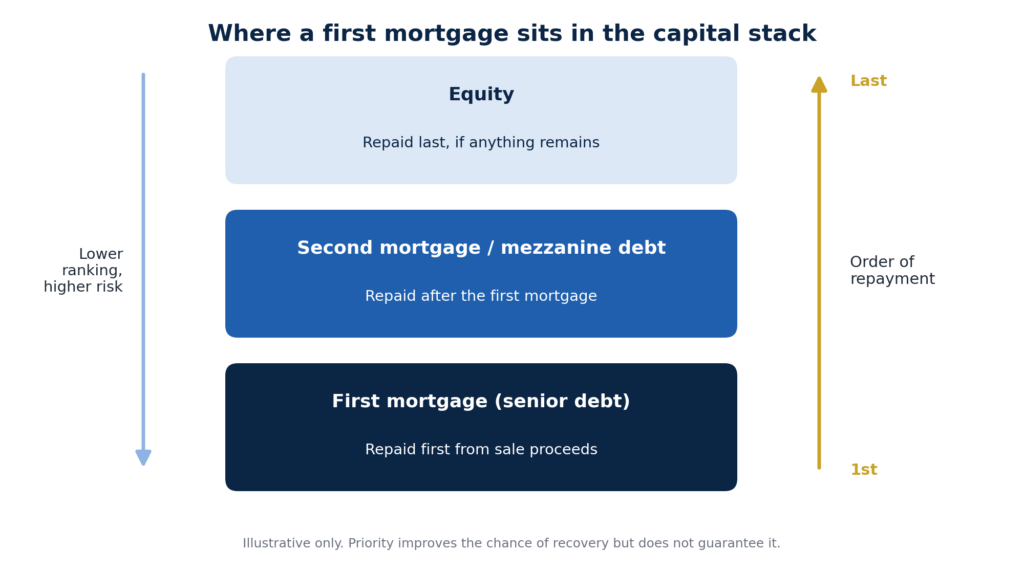
A first mortgage sits at the base of the capital stack, so it is repaid first from sale proceeds, ahead of second mortgages, mezzanine debt and equity.
Most first mortgage funds are structured as managed investment schemes, with a professional manager running the loan book. You are not buying the property; you are funding loans secured against it. That makes it a different exposure from owning property through an equity fund, which we explain in Managed Property Funds in Australia.
How First Mortgage Lending Works
Every loan in a first mortgage fund follows a similar path, from application to repayment.

Each loan moves through six stages, with the security and credit assessments determining whether investor capital is advanced.
The first-ranking position matters most at the final stage. It improves the chance of recovery if a borrower defaults, but it is not a guarantee: if property values fall or enforcement takes longer than expected, sale proceeds may not cover the loan, interest owed and recovery costs.
Why Wholesale Investors Consider First Mortgage Funds
| Feature | Why investors value it | What to keep in mind |
|---|---|---|
| Priority security | A first claim on sale proceeds, ahead of later-ranking lenders | Recovery depends on the property's value at the time |
| Income focus | Returns come mainly from borrower interest, not capital growth | Distributions are not guaranteed and can be reduced |
| Defined loan terms | Loans have set maturity dates | Loans can be extended or repaid late |
| Value buffer | Conservative loan-to-value ratios (LVRs) leave room for property values to fall | The buffer shrinks if valuations are out of date |

At a 65% LVR, a property’s value could fall by 35% before the loan exceeds the security, and less once interest owed and recovery costs are included. The lower the LVR, the larger the cushion for investors.
These strengths hold up best with conservative LVRs and independent valuations. For context, see Why Residential Land Matters in Australian Property Funds.
Key Risks Investors Should Understand
Secured lending reduces some risks, but it does not remove them. The main risks include:
- Credit risk: borrowers may default.
- Property market risk: falling values may leave the loan uncovered.
- Liquidity risk: withdrawals may be limited or suspended, and in closed-end funds there may be no right to withdraw until the fund term ends.
- Interest rate risk: rate changes can affect refinancing and repayment timing.
- Construction risk: projects can run late or over budget, builders can fail, and an as-if-complete value may not be achieved, leaving the security worth less than expected until the project is finished.
- Concentration risk: a large share of the loan book with one borrower, developer or project means a single problem can affect the whole fund.
- Fund level gearing risk: some funds borrow at the trust level to lift returns; that lender ranks ahead of investors, so any losses fall on investors first and are magnified.
- Valuation and manager risk: stale valuations or weak lending discipline can hide problems.
A first mortgage fund is not a bank deposit and is not covered by the government’s Financial Claims Scheme. Capital is at risk and returns are not guaranteed. Our guide to Risk Assessment in Property Funds explains how to test these risks.
A Due Diligence Checklist Before You Invest
ASIC’s Report 814 on private credit highlights valuation practices and fee transparency as areas that vary between managers. These questions help compare funds on the same terms:
| Check | What to look for |
|---|---|
| Loan-to-value ratio | Maximum LVRs by loan type and the average across the loan book |
| Valuations | Independent valuers, regular updates, and whether LVRs use current as-is values or as-if-complete forecasts |
| Arrears and defaults | How many loans are late and the manager’s plan to resolve them |
| Construction loans | The share of the book in construction loans, independent verification of progress payments, builder strength, and contingency for cost overruns |
| Concentration | Exposure to single borrowers, regions or projects |
| Fund level gearing | Whether the fund itself borrows, how much, and who ranks ahead of investors |
| Withdrawals | Whether the fund is open or closed-end, notice periods, limits and what happens if requests exceed available cash |
| Fees | All fees and their effect on net returns |
| Track record | A verifiable lending history, and an Australian Financial Services licence held by, or covering, the manager |
Read the risk section of the offer documents first, and treat a first mortgage fund as one part of a diversified portfolio. Listed vs Unlisted Property Funds explains how unlisted structures like these differ on liquidity and pricing.
Speak With Our Investment Team
Our investment team can explain how our first mortgage lending is structured, managed and reported on. You can also explore our current funds or find more analysis on our Insights page.
Frequently Asked Questions
A first mortgage fund pools investor capital to make loans secured by a registered first mortgage over property. Investors earn income from borrower interest, after fees and costs.
First mortgage funds generate income from the interest borrowers pay on their loans. Income is distributed after fees, costs and any reserves, and is not guaranteed.
The loan-to-value ratio compares a loan with the property’s value. A lower LVR leaves a larger buffer if values fall, improving the chance of full recovery if a borrower defaults.
Sources
- Private credit market size and real estate share — ASIC Report 814: Private credit in Australia
- Definition of a managed investment scheme — ASIC: Managed investment schemes
- Scope of the government deposit guarantee — APRA: Overview of the Financial Claims Scheme
- Wholesale and sophisticated investor thresholds (ss 708, 761G) — Corporations Act 2001 (Cth)
Important information
This article is general information only and has been prepared for wholesale investors. It does not take into account your objectives, financial situation or needs and should not be considered personal financial advice. Investments involve risk, including possible loss of capital. Past performance is not a reliable indicator of future performance. Investors should review the relevant offer documents and seek independent advice before making any investment decision.